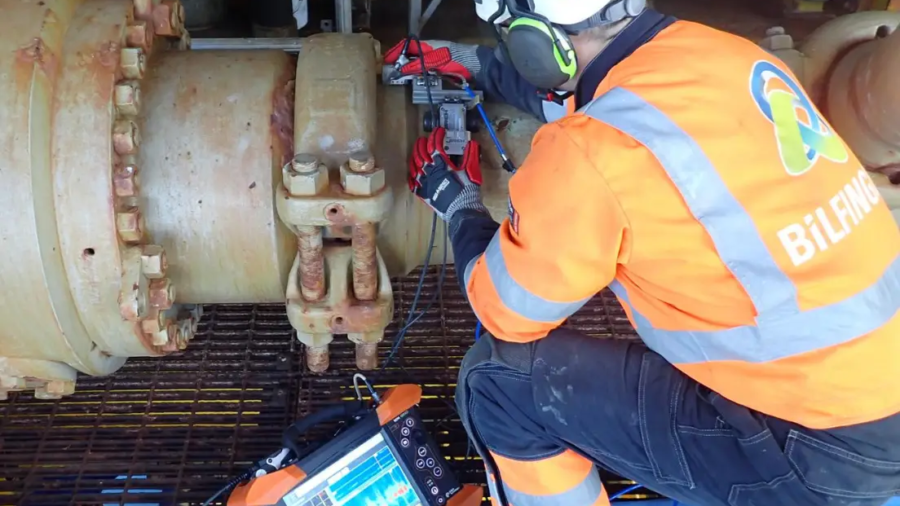

NDT technicians inspecting industrial equipment.

5 Industries That Are Actively Hiring NDT Technicians

Non-Destructive Testing (NDT) isn’t a niche skill anymore. It’s become one of the more dependable technical careers out there, mostly because the work it does is impossible to skip. Pipelines, aircraft parts, pressure vessels, steel structures anything that could fail catastrophically has to be checked without being cut open or damaged in the process. That’s the whole job of an NDT technician and right now, a surprising number of industries are competing for people who can do it well. There’s also a practical reason this matters right now. A lot of people assume NDT is a one-industry skill, tied purely to oil and gas. That’s not really true anymore. Regulations around structural safety have tightened across nearly every sector that deals with heavy machinery or load-bearing structures and the technicians trained to spot problems early are in demand well beyond rigs and pipelines.

If you’re trying to figure out where this skill set actually leads, here are five industries hiring NDT technicians at a steady pace and why each one is worth a serious look.

1. Oil and Gas

This is the industry most people think of first and honestly, it earns that reputation. Offshore platforms, refineries, storage tanks all of it runs under extreme pressure, in corrosive, high-vibration environments where a hairline crack in a weld can turn into a major shutdown or worse. Ultrasonic testing, radiographic testing, magnetic particle inspection, technicians here rotate through all of it depending on what needs checking.

Offshore work specifically tends to demand technicians who understand more than just the testing side. Saltwater corrosion alone creates constant wear on equipment, so a lot of professionals end up pairing their NDT certification with an oil and gas diploma just to get a fuller picture of the rig environment they’re inspecting not only the flaw they’re looking for but why it’s forming in the first place.

Onshore refineries hire just as steadily, often around scheduled “turnarounds,” where a whole processing unit shuts down for a short window purely for inspection and maintenance. Those windows are short, intense and well paid. A good example of how the demand in this sector isn’t just one steady stream, it comes in bursts too.

2. Aerospace Manufacturing

Nowhere is precision taken more seriously than in aerospace. A missed defect in a turbine blade or a fuselage weld isn’t a minor issue, it’s a safety failure waiting to happen. That’s why aircraft manufacturers lean so heavily on eddy current testing and radiography and why the technicians doing that work are held to an unusually tight standard. What’s interesting about aerospace is that the demand doesn’t stop once a plane rolls out of the factory. Every aircraft in commercial service goes through recurring structural checks for its entire operating life, which means MRO (maintenance, repair and overhaul) facilities need technicians just as much as manufacturers do. In a lot of ways, this overlaps with how QA/QC teams operate in oil and gas both roles exist to catch a problem before it becomes someone else’s emergency.

3. Automotive and Heavy Manufacturing

As cars get more complex especially with EVs and hybrid drivetrains entering the mix, manufacturers are relying more on NDT to catch flaws in castings and welds before a vehicle ever leaves the factory floor. It’s a different rhythm of work compared to oil and gas or aerospace: mostly factory-based, more predictable hours, less field travel. That predictability is actually a selling point for a lot of technicians. And as automakers adopt automated inspection systems alongside traditional methods, there’s growing demand for people who can work comfortably with both, someone who understands the fundamentals of testing but isn’t intimidated by the newer digital tools showing up on production lines.

4. Construction and Infrastructure

Bridges, high-rises, dams none of these get built (or maintained) without structural checks that go well beyond a visual walk-through. NDT technicians here test welds on steel frameworks, check concrete reinforcement and confirm load-bearing components actually meet code, both during construction and years afterward. A lot of older infrastructure is legally required to undergo periodic re-testing, which creates fairly consistent inspection contracts regardless of how much new construction is happening in a given year. It’s also one of the more accessible entry points for someone early in their career, since construction sites often need technicians comfortable with a mix of testing types and there’s some natural crossover here with fire and safety inspection work too, given how tightly structural integrity and fire compliance are linked in large buildings.

5. Power Generation

Thermal plants, nuclear facilities, renewable energy sites all of them depend on inspection cycles that are non-negotiable. Boilers, turbines and pressure piping operate under extreme heat and stress and an undetected flaw here doesn’t just mean downtime, it can mean a serious safety incident. Power plants typically schedule shutdowns specifically for inspection and maintenance and NDT technicians are central to that process every time. What makes this sector particularly stable is that these inspection cycles are mandated by regulation, not left up to a company’s discretion, so the work tends to hold steady even when the broader economy slows down. As more renewable energy projects come online too, that’s opening up a slightly different flavor of inspection work testing welds on wind turbine towers or solar structural mounts, for instance which means the sector isn’t just thermal and nuclear anymore, it’s expanding in newer directions as well.

What Employers Are Actually Looking For

Across all five industries, the baseline skill set doesn’t change much: ultrasonic testing, radiographic testing, magnetic particle inspection, dye penetrant testing, eddy current testing. Most candidates coming out of a certification program know the theory. What separates the ones who actually get hired is hands-on repetition, enough practice to read results correctly under real working conditions, not just in a controlled classroom setup. Employers also tend to notice technicians who understand the bigger picture, how a missed defect could ripple into a production delay, a safety violation or a much bigger repair bill down the line. That kind of judgment usually comes from training that’s grounded in real industry scenarios, not just textbook procedure.

Why NDT Still Makes Sense as a Career

What ties these five industries together is pretty simple: safety regulations aren’t loosening and aging infrastructure isn’t getting any younger. Both point toward demand that isn’t going away anytime soon. And unlike a lot of technical roles being chipped away by automation, NDT still needs a trained person to interpret what the equipment is showing which keeps the human element firmly in the loop, even as the tools get more advanced.

For anyone in Kerala looking to break into this field, certification is the obvious starting point. A proper NDT Level II course in Kerala gives you working exposure across multiple testing methods which matters more than it sounds. It’s what keeps your options open across industries instead of boxing you into just one.

Conclusion

NDT technicians aren’t confined to a single corner of the industrial world anymore. They’re needed wherever structural safety actually matters, from offshore rigs to aircraft hangars to power stations. That range is really the appeal of this career: the skills carry over and the demand doesn’t hinge on one industry’s ups and downs. At Rig Offshore Academy, training students for exactly that kind of multi-industry readiness has been the focus with an emphasis on the practical, hands-on skills that employers actually check for, not just the ones listed on a certificate. If you’re serious about building a career in NDT, a structured, industry-relevant program is still the most reliable way to get there.
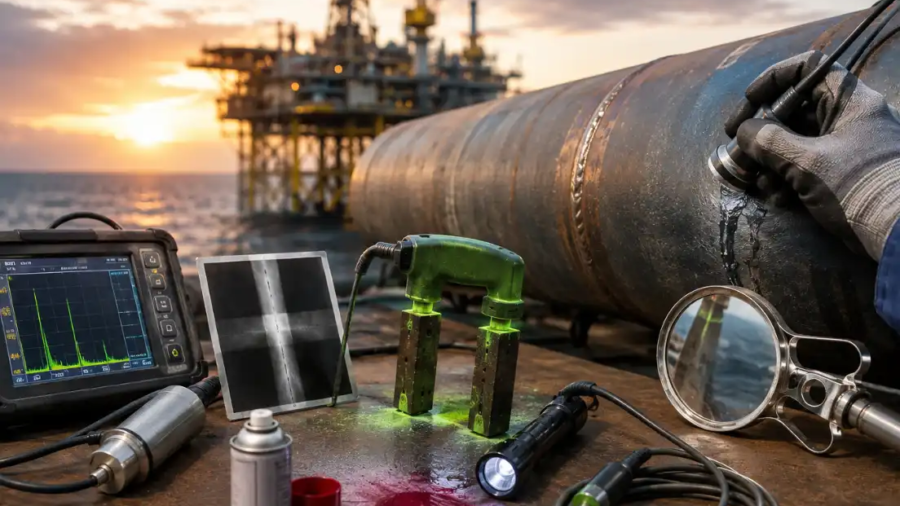

types of ndt , the rig offshore academy

What Are the Different Types of NDT? A Beginner’s Guide for Oil & Gas Careers

Ever wondered how someone inspects a pipeline, a weld or an offshore rig structure without cutting it open? That’s Non-Destructive Testing or NDT for short. It’s a set of inspection methods that let technicians check whether a material or component is sound without damaging it or taking it out of service. If you’re looking into a career in oil and gas, getting familiar with the different types of NDT is a good place to start. This guide walks through the main NDT methods, what each one is actually good for, and why this skill has become such a big deal in oil and gas, shipbuilding, and heavy manufacturing.

Why NDT Matters in Oil & Gas

Offshore platforms, pipelines, storage tanks, pressure vessels – these all take a beating from stress, heat, and corrosion, day in and day out. One missed flaw in a weld or a pipe wall, and you’re looking at a leak, or worse, a structural failure. So regulators and safety standards require these things to be inspected regularly, throughout their working life. That’s the job NDT does. It lets inspectors catch cracks, corrosion and voids early, without dismantling or damaging whatever they’re checking. It’s also become one of the most in-demand skills in the oil and gas sector and honestly, a solid way into a technical career offshore.

The Main Types of NDT

Different jobs call for different methods, depending on the material, the kind of defect you’re chasing, and how the inspection needs to happen. Here’s a rundown of the ones worth knowing.

1. Ultrasonic Testing (UT)

UT sends high-frequency sound waves through a material to pick up on internal flaws like cracks, voids, or thinning walls. A probe fires the waves in, and any change in what bounces back tells you something’s wrong. It’s a go-to for checking weld quality and measuring wall thickness on pipelines and pressure vessels, particularly where corrosion is suspected.

2. Radiographic Testing (RT)

RT works a lot like a medical X-ray – it uses X-rays or gamma rays to produce an image of what’s happening inside a component. It’s excellent for catching internal issues like porosity, inclusions, or incomplete fusion in welds. The catch is radiation, which means strict safety protocols and properly trained operators are non-negotiable.

3. Magnetic Particle Testing (MT)

This one only works on ferromagnetic materials. A magnetic field gets applied to the part, then fine iron particles are scattered over the surface. Wherever there’s a crack or discontinuity, the particles bunch up and make the flaw visible. It’s quick, cheap, and a common choice for inspecting welds and structural steel.

4. Penetrant Testing (PT)

Also called Dye Penetrant Inspection. A liquid dye seeps into any surface cracks, and a developer draws it back out so the flaw shows up. What makes PT popular is how simple and low-cost it is – no electricity, no complicated setup. The trade-off is it only picks up defects that are open to the surface.

5. Visual Testing (VT)

The most basic method on this list, and often the first thing an inspector does. Sometimes it’s just a trained eye; sometimes it’s a borescope, mirror, or magnifier. Don’t underestimate it, though – VT catches obvious problems like corrosion or misalignment before anyone reaches for more advanced tools.

6. Eddy Current Testing (ET)

ET uses electromagnetic induction to find surface and near-surface flaws in conductive materials. It’s particularly handy for tubing, heat exchangers, and thin-walled parts, and can even sort materials or measure coating thickness. Fast, and in some setups it doesn’t even need direct contact with the surface.

Choosing the Right NDT Method

There’s no single method that covers every situation. What you use depends on the material, the type of defect you expect, how accessible the part is, and whether the flaw is likely to be on the surface or buried inside. In the field, technicians often stack methods together – say, a quick visual pass followed by ultrasonic testing for a deeper look – to get the full picture. And this is really why hands-on training matters so much. Knowing how each method works on paper only gets you so far. Real skill comes from actually running these tests on equipment, under proper supervision.

Building a Career Around NDT

If you’re weighing technical career options in oil and gas, NDT is one of the more practical specializations out there. Demand for it holds steady across offshore platforms, refineries, pipeline networks, and fabrication yards, and it opens a fairly clear path – from entry-level inspector roles up to quality control and asset integrity positions later on. That’s where proper, industry-aligned training comes in. At the best oil and gas institute in kerala, students work directly with these inspection methods as part of a curriculum built around what the industry actually expects, not just classroom theory. Beyond NDT, the academy also runs programs in oil and gas courses in calicut, qa and qc course in kerala  and fire and safety course in calicut, so students come out with a broader footing across the areas offshore employers care about.

If inspection is specifically where your interest lies, the NDT Level II course in Calicut takes you from the basics covered here through to hands-on, certifiable skill in UT, RT, MT and PT.

Conclusion

Ultrasonic, Radiographic, Magnetic Particle, Penetrant, Visual, Eddy Current – each type of NDT brings something different to the table, and knowing which one fits a given job is what sets a decent technician apart from a genuinely good one. Whether you’re just curious about how offshore inspections actually happen, or you’re seriously weighing a move into this field, spending time understanding NDT now pays off later – especially once you pair that understanding with the right hands-on training.

NDT technician performing ultrasonic inspection

Career Scope After NDT Training in the Oil and Gas Sector

Ever wonder how a pipeline that’s been sitting underground for twenty years, or a rig platform getting battered by salt water every single day, doesn’t just fail out of nowhere? Somebody’s checking it. Constantly. And they’re doing it without cutting the metal open or taking anything apart. That’s NDT – Non-Destructive Testing – and it’s one of those careers people don’t hear much about until they’re already looking for a technical job in oil and gas. If you’re weighing your options right now, here’s the short version: NDT training is one of the more practical, steady paths into this industry. It’s technical enough that not everyone can do it, which keeps demand high and it applies to almost every stage of oil and gas work – onshore, offshore, refineries, pipelines, you name it. Let’s get into why, and where it can actually take you.

What NDT Training Involves

At its core, NDT means checking welds, tanks, pipes and structural parts for cracks, corrosion, or hidden weak points, using methods like ultrasonic testing, radiography, magnetic particle inspection and dye penetrant testing. None of these damage what’s being tested. That’s the whole point – you get the answer without wrecking the part. A decent training program doesn’t just throw theory at you. It puts you in front of real equipment, walks you through safety protocols and gets you ready for internationally recognized certification standards like ASNT SNT-TC-1A. Most people progress through levels – Level I, then Level II, eventually Level III if they stick with it – and each step up means more responsibility and a better paycheck.

Why This Industry Depends on NDT Technicians So Heavily

Oil and gas equipment takes a beating. Pipelines are pushing corrosive fluid under pressure all day. Offshore rigs deal with saltwater and brutal weather. Refineries run hot, nonstop. One missed crack in a weld and you’re looking at a leak, or worse, an explosion that costs millions and puts people’s lives on the line. That’s exactly why inspections aren’t optional – they’re written into safety regulations and company policy. And because they’re mandatory, the demand for people who know how to do them properly just doesn’t dry up. If anything, as infrastructure across the world keeps aging, there’s more inspection work coming, not less.

Where NDT Training Can Take Your Career

This is really the part people care about most. Here’s what the career ladder tends to look like once you’re certified.

NDT Technician (entry to mid-level)

Most people start here. As a Level I or Level II technician, you’re the one out on the plant floor or at the site, running the ultrasonic or radiographic tests yourself, writing up what you find and flagging anything that needs a closer look. Pay at this stage is already decent compared to a lot of other technical trades and it goes up fast once you’ve logged enough field hours and picked up more certifications.

Quality Control Inspector

A lot of technicians move into QC roles eventually. Instead of just running the tests, you’re overseeing the bigger picture – making sure welds actually meet spec, materials pass whatever standard applies and the paperwork holds up during an audit. If you already understand inspection at a technical level, this move feels pretty natural.

Site Supervisor or NDT Team Lead

Enough years in the field and you start managing people instead of just equipment. This means scheduling inspections across a site, reviewing everyone’s reports, training the newer technicians and talking directly with project engineers. Less hands-on with the tools, more about keeping the whole operation running smoothly.

NDT Level III Specialist

Getting to Level III is a big deal. These are the people writing the inspection procedures, approving which techniques get used on a job, certifying other staff and settling disputes when two inspectors disagree on a result. It’s one of the highest-paying tiers in this field and it comes with a lot of respect industry-wide.

Consultant or Independent Inspector

Once you’ve built up a solid reputation and a stack of certifications, going independent becomes a real option. Companies bring in outside NDT consultants for one-off audits, third-party checks, or specialized jobs their own team can’t handle. It’s not for everyone, but it’s a legitimate path.

Working Abroad

Certifications under ASNT or PCN standards travel well internationally. So someone trained in India, for example, can end up working across the GCC, Southeast Asia, or Europe without starting from scratch. The Middle East especially has a strong appetite for skilled NDT professionals, often with tax-free pay that makes the move worthwhile.

It’s Not Just Oil and Gas

Oil and gas is the biggest employer for NDT-certified people, sure, but the skills carry over into aerospace, shipbuilding, power plants and construction too. That cross-industry demand is honestly one of the underrated perks – even if oil and gas hiring slows down for a stretch, there are other sectors that need the exact same skill set.

What Actually Makes You More Hireable

Passing the certification gets you in the door. A few other things separate the people who move up quickly from the ones who stall:

  • Being able to write a clear, accurate inspection report – engineers and auditors need to read it fast and trust it
  • Knowing more than one NDT method instead of specializing narrowly, since employers usually want flexibility
  • A working understanding of welding and metallurgy, so you actually know what you’re looking at
  • Being okay with physically demanding environments, particularly if offshore work is on the table
  • Being open to relocating, since a lot of the better-paying jobs are offshore or overseas

Starting Off on the Right Foot

Where you train actually matters more than people expect. A lot of aspiring technicians end up underprepared because their program leaned too hard into theory and didn’t give them enough real time with equipment. That gap shows up fast once you’re on an actual job site.

Rig Offshore Academy as the best oil and gas institute in kerala was built specifically to close that gap – training that’s hands-on and matches what real offshore and onshore work actually looks like, not just what gets you through an exam. For anyone wanting a solid grounding in ultrasonic and radiographic testing specifically, the NDT Level II course in Calicut is worth a look – it takes you from the basics straight through to the practical skills employers are actually checking for.

Conclusion

NDT training leads somewhere real. Whether you end up as a field technician, move into QC, climb to Level III or eventually go independent, there’s a clear path forward as you rack up experience. And since the skills transfer to industries well beyond oil and gas, it’s a genuinely solid entry point for anyone chasing a stable technical career. Where you start still matters, though. A program that actually gets you hands-on with the equipment, like the one at Rig Offshore Academy, is what separates people who walk into their first inspection job with confidence from people who are still figuring it out on someone else’s dime.

Oil and gas inspection work

QA/QC vs NDT: Understanding the Key Differences in Oil & Gas Careers

If you’re exploring a career in the oil and gas sector, you’ve probably come across two terms that sound related but actually lead down very different professional paths: QA QC and NDT. Both fields are essential to keeping oil and gas operations safe and compliant, but they involve different skill sets, daily responsibilities and career trajectories. For students trying to decide which course to enroll in, understanding these differences early can save time, money and a lot of confusion later.

In this blog, we’ll break down what QA QC and NDT actually mean, how they differ in practice, what kind of work each role involves and which one might suit your interests and career goals better.

What is QA QC?

QA QC stands for Quality Assurance and Quality Control. Though the two terms are often used together, they refer to slightly different functions within the same discipline.

Quality Assurance is a process-oriented function. It focuses on setting up systems, procedures and standards that prevent defects before they happen. A QA engineer is concerned with whether the right processes are being followed throughout a project from material selection to welding procedures to documentation.

Quality Control, on the other hand, is product-oriented. It involves inspecting, testing and verifying that the finished product or work actually meets the required specifications. A QC inspector checks welds, materials, dimensions and finished components against approved standards and drawings.

In the oil and gas industry, QA QC professionals are involved at almost every stage of a project from procurement and fabrication to installation and commissioning. They review documentation, conduct audits, coordinate with third-party inspection agencies and ensure that every stage of construction or fabrication complies with international codes and client specifications. If you’re looking to build a career in this field, enrolling in a qa qc course in calicut is a good starting point to get hands-on with these industry standards.

What is NDT?

NDT stands for Non-Destructive Testing. As the name suggests, it is a set of testing techniques used to examine the properties of a material, component, or system without causing any damage to it. This is critical in industries like oil and gas, where pipelines, pressure vessels and structural welds need to be inspected repeatedly throughout their service life without being cut open or destroyed.

Common NDT methods include:

  • Radiographic Testing (RT) – using X-rays or gamma rays to detect internal flaws
  • Ultrasonic Testing (UT) – using high-frequency sound waves to find internal defects
  • Magnetic Particle Testing (MPT) – detecting surface and near-surface flaws in ferromagnetic materials
  • Liquid Penetrant Testing (LPT) – identifying surface-breaking defects using dye penetrants
  • Visual Testing (VT) – the most basic and widely used method, involving direct visual inspection

NDT technicians are trained specifically in these techniques and are certified according to standards such as ASNT SNT-TC-1A or ISO 9712. Their job is highly technical and hands-on, requiring precision, patience and a strong understanding of material science and defect interpretation. If you want to specialize in these techniques, our ndt level ii course in Calicut covers all five methods with practical, hands-on training.

Key Differences Between QA QC and NDT

While both fields fall under the broader umbrella of quality and inspection in oil and gas, here’s how they actually differ:

1. Scope of work QA QC covers a much wider scope. It includes documentation control, process audits, vendor evaluation, procedure verification and overall project quality management. NDT, in comparison, is a specialized technical function focused purely on detecting flaws in materials and welds using specific testing equipment.

2. Skill set required A QA QC professional needs strong organizational, documentation, and communication skills, along with knowledge of quality standards like ISO 9001, API and ASME codes. An NDT technician needs strong technical and equipment-handling skills, along with the ability to interpret radiographs, ultrasonic signals and magnetic particle indications accurately.

3. Certification path QA QC professionals typically pursue courses and certifications related to quality management systems, welding inspection (like CSWIP or AWS) and ISO auditing. NDT technicians pursue level-based certifications (Level I, II and III) in specific methods such as RT, UT, MPT and LPT, governed by bodies like ASNT.

4. Career progression QA QC often leads to roles like QA/QC Engineer, QA/QC Manager, or Quality Manager, with responsibilities expanding into project-wide quality leadership. NDT careers often progress from Technician to Level II or Level III Inspector and experienced NDT professionals can also move into QA QC roles later in their careers, since NDT knowledge is valuable for quality oversight.

5. Nature of daily work QA QC work involves a mix of site visits, documentation review, meetings and audits. It’s less hands-on with equipment and more focused on oversight and coordination. NDT work is hands-on and field-intensive, often involving physically testing welds and components using specialized equipment on-site.

Which One Should You Choose?

The honest answer is that it depends on your interests and strengths.

If you enjoy working with documentation, coordinating between teams, understanding codes and standards and taking a broader view of project quality, QA QC might be the better fit. It also tends to offer a clearer path into managerial roles over time.

If you’re more hands-on, enjoy technical precision and like the idea of physically testing materials and interpreting results using specialized equipment, NDT could be more satisfying as a long-term career. NDT also has strong demand across pipeline, refinery and offshore platform inspection work.

It’s worth noting that many professionals in the industry actually build careers that combine both. Starting as an NDT technician and later moving into a QA QC role is a fairly common and respected career path, since it gives you both the technical grounding and the process knowledge needed for senior quality positions.

Salary and Job Demand: QA QC vs NDT

Salary expectations for both fields vary based on experience, certification level and location but there are some general trends worth knowing.

Entry-level QA QC roles in the Gulf region typically start with steady growth potential, since the role naturally expands into supervisory and managerial positions over time. As professionals gain experience and add certifications like CSWIP or ISO Lead Auditor, their responsibilities and pay tend to increase significantly, especially in large-scale EPC (Engineering, Procurement and Construction) projects.

NDT roles, particularly at Level II and Level III are in consistent demand across pipeline inspection, refinery turnarounds and offshore rig maintenance. Because NDT certification is method-specific and internationally recognized, technicians who hold multiple method certifications (say, both UT and RT) often find themselves more employable and better compensated than those with a single certification.

In both fields, experience in the Middle East, particularly in the UAE, Saudi Arabia and Qatar, tends to open up higher-paying opportunities compared to entry-level positions in India. This is one reason many students choose to complete their training in India before pursuing job opportunities in Gulf countries.

Common Misconceptions

There are a few misconceptions that often confuse students choosing between QA QC and NDT.

One common myth is that NDT is a “lower-level” job compared to QA QC. In reality, senior NDT inspectors, especially Level III certified professionals, often earn as much as or more than mid-level QA QC engineers, given how specialized and in-demand their skills are.

Another misconception is that QA QC doesn’t require technical knowledge. In practice, a QA QC engineer needs a solid understanding of welding processes, material properties and inspection techniques (including NDT methods) in order to review documentation and audits effectively. You can’t manage what you don’t understand.

Finally, some students believe they have to choose one path permanently. As mentioned earlier, it’s fairly common and often advantageous to start in NDT and later transition into QA QC once you’ve built a strong technical foundation.

Why Rig Offshore Academy is the Right Place to Start

Choosing the right course is just as important as choosing the right field. At Rig Offshore Academy, students get access to industry-relevant training in both QA QC and NDT, taught by experienced professionals who understand what employers in the oil and gas sector actually look for. The courses are structured to combine theoretical understanding with practical exposure, so students leave not just with a certificate, but with the confidence to handle real site conditions.

As one of the best oil and gas institute in kerala, Rig Offshore Academy has built a strong reputation for placing students in reputable companies across the Middle East and beyond. Whether you’re drawn to the documentation and process-driven world of QA QC or the technical precision of NDT, the academy’s training programs are designed to give you a genuine head start in the industry.

Conclusion

QA QC and NDT are both critical functions in the oil and gas industry, but they serve very different purposes. QA QC is about process oversight, documentation and ensuring overall project quality, while NDT is about hands-on technical testing to detect flaws without damaging materials. Neither one is inherently “better” than the other, the right choice depends on whether you’re drawn to broader quality management or focused technical inspection work.

Whichever path you choose, getting trained at an institute with strong industry connections and practical teaching methods will make all the difference in how quickly you find your footing in the field. If you’re serious about building a career in oil and gas quality and inspection, Rig Offshore Academy is a solid place to begin that journey.