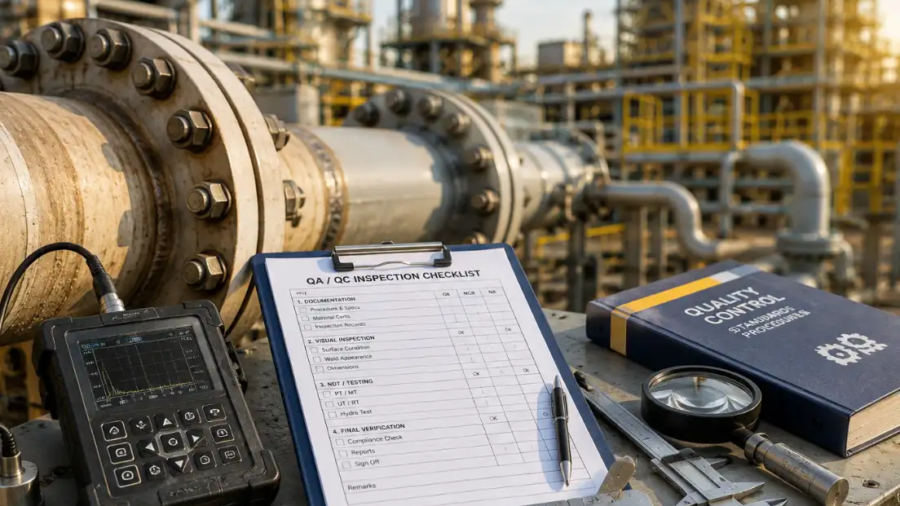

Not every well-paid job in oil and gas means hauling pipe on a rig. A QA QC career is built on a different skill: checking that work was done correctly. You carry drawings, a checklist and the authority to say that a weld or a pipe is not acceptable. In an industry where one bad joint can shut down a plant, that authority is valued and paid for.
This guide explains what QA QC means, the roles you can grow into, what they pay in India and the Gulf and how a fresher can get started. The salary figures are rough, so check live job listings before you plan around them.
What QA and QC Actually Mean
People often mix up the two letters. QA is quality assurance and it is about the system: the procedures, plans and documents that make good work likely. QC is quality control and it is about the product: inspecting the actual weld, pipe, coating or valve to see whether it meets the standard. On real projects the two overlap, which is why employers advertise “QA/QC” roles. The drawings and the client’s specification say what is required. The QA/QC team proves, through inspection and paperwork, that it was done.
Why Oil and Gas Needs This Work
Oil and gas plants run at high pressure and high temperature, often with flammable material inside the pipes. A weak weld is not only a repair bill. It can mean a leak, a fire or an injury. Because of that, clients and regulators demand strict codes and every project must show records of what was built and how it was tested. That paperwork requirement creates steady demand for QA/QC people, whether a company is laying a new pipeline or maintaining an old plant.
Roles in a QA QC Career, Step by Step
Most people climb through these stages:
- QC trainee or documentation assistant. You learn the paperwork, help with inspection records and follow senior inspectors around the site.
- QC inspector. You inspect welding, piping, painting or mechanical work against the drawings and codes and you write the inspection reports. Many people stay in this role for several years and specialise in one area.
- QA/QC engineer. You plan inspections, review contractors’ procedures, handle quality documents and deal with the client’s representatives.
- QA/QC supervisor or lead. You manage a team of inspectors and decide what gets accepted, repaired or rejected.
- QA/QC manager or auditor. You run the quality system for a whole project or company and answer for it when the client audits.
You do not need to rush through every level. Strong inspectors with good certificates are often paid better than engineers who have no field credibility.
What the Work Looks Like Day to Day
Expect a mix of site and desk time. A morning might mean walking a pipe rack to check weld joints, material markings and supports. After lunch you could be in the site office, matching test reports to drawings and chasing a missing signature. The job needs patience more than muscle. Small details, like a wrong heat number or a missing record, can hold up a whole section of a project. Inspectors who notice these things early save their companies a great deal of money.
QA QC Career Salary in India and the Gulf
Pay depends on your certificates, your experience and where you work, so treat these numbers as a rough guide only.
In India, a trainee or junior QC person often starts around ₹15,000 to ₹25,000 a month. Certified inspectors commonly earn about ₹30,000 to ₹70,000 and QA/QC managers on large projects can earn more than that.
The Gulf pays more at each stage. Juniors may see roughly AED 1,500 to 3,000 a month, while certified inspectors commonly earn about AED 3,500 to 8,000. Senior engineers and managers can go beyond AED 10,000. Gulf packages often add accommodation, transport and an annual flight, which raises what you can save.
Skills and Certificates That Help
Employers look for proof that you can do the work, not just talk about it. The skills that matter most are:
- Reading engineering drawings
- Basic knowledge of welding and piping
- Understanding of inspection codes and procedures
- Clear report writing
- Honest, careful habits
On the certificate side, welding inspection credentials are well known. The American Welding Society offers its Certified Welding Inspector programme and TWI runs CSWIP certification, which is widely recognised in Gulf oil and gas. Many inspectors also learn at least one NDT method, because testing and inspection go together. A programme like NDT Level 2 training makes a QC profile noticeably stronger.
Growth: Where a QA QC Career Can Lead
After a few years, the paths open up. You can become a senior inspector in a speciality such as welding or coatings. You can move to third-party inspection, where you check work on behalf of a client. You can step up to project quality management. Some people combine QC with NDT and become the technical authority on a site. QA/QC also travels well. Standards and codes are similar from one country to another, so your skills move with you. If you enjoy the testing side, our NDT career guide explains how that related path works.
Is a QA QC Career Right for You?
It suits people who like order, notice small things and can say no politely when something is wrong. It is a good choice if you want a technical job that is not purely physical. It is not for everyone. You will still spend time outdoors in heat and dust, you may face pressure from contractors who want work accepted quickly and a careless signature can have real consequences. If you cannot stand paperwork, this will frustrate you.
How to Get Started
Most people enter after Plus Two, ITI or a diploma in mechanical, civil or a related trade. A degree helps for engineer roles, but inspector roles are open to people with strong skills and certificates. Training matters because employers can tell who has handled real drawings and inspection tools. Before you join any institute, ask how many practical hours you will get, which certification body the course follows and what help is given with job placement.
The oil and gas institute in kerala, Rig Offshore Academy in Kozhikode runs a dedicated QA/QC course and also offers NDT, Fire and Safety and an Oil and Gas Diploma, so students can add a second skill as their plans grow.
Conclusion
A QA QC career gives you something many entry-level paths do not: respect on site, a clear ladder from trainee to manager and skills that work across companies and countries. Pay starts modestly, rises with certificates and goes further once Gulf packages are included. The price is careful attention, some paperwork and the responsibility to report honestly. If that sounds like you, the next step is practical training that leads to a recognised certificate. Check current salaries against live listings, ask direct questions of any institute you consider and begin building site-ready skills early. Done well, QA/QC can turn a Plus Two certificate or a diploma into a career that lasts for decades.