
Oil and gas job opportunities on an offshore platform

Do You Need a Degree to Get an Oil and Gas Job? Here’s the Truth

Ask around and you’ll hear the same thing over and over: you need an engineering degree to land an oil and gas job. It’s repeated so often that people who’d otherwise be great candidates talk themselves out of applying before they’ve even looked at what the job actually requires. Here’s the part nobody mentions enough. Most of the industry isn’t built around degree holders at all. Yes, roles like petroleum engineers or reservoir geologists need a university background. But those are a small slice of the workforce. Walk onto a rig or into a refinery and the majority of people working there got in through certification programs, apprenticeships and hands-on technical training not four years of college.

Where the Confusion Comes From

A lot of it comes down to how career advice gets written. General job sites tend to write about “oil and gas careers” as if it’s one category, when really it covers dozens of completely different paths. Someone researching how to become a drilling engineer and someone researching how to land an oil and gas job as a fire and safety technician are looking at two entirely different hiring processes, but they often land on the same generic article that doesn’t separate the two. There’s also the simple fact that technical training pathways have matured a lot faster than public awareness of them. NDT inspection, QA/QC and fire and safety work are now well-established, well-paying specializations with structured certification routes but a lot of people still think of them as vague “labor jobs” rather than skilled, certified trades.

The Jobs That Don’t Ask for a Degree

Once you actually look at hiring criteria instead of general assumptions, the picture changes quickly. A large chunk of oil and gas roles are open to anyone with the right certificate and some practical training behind them.

Fire and safety technicians are a good example, this work is built almost entirely around structured safety certification and demand for trained personnel rarely slows down across rigs, plants and industrial sites. NDT (Non-Destructive Testing) technicians, who inspect welds and structural components for defects, get hired based on Level I and Level II certification, full stop, a degree doesn’t come into it. QA/QC inspectors, who check that materials and workmanship meet spec, usually come from vocational or diploma-level training rather than a bachelor’s program. Then there’s the operational side, roughnecks, rig hands and general offshore crew where most people learn on the job after completing a short preparatory course. Even instrumentation and electrical technicians, who keep a platform’s systems running, typically enter through diploma-level technical education rather than a full engineering degree. Every one of these paths has its own pay scale and career ladder, but they all share the same entry logic: what you’re certified to do matters more than what’s printed on a degree certificate.

What Employers Are Actually Screening For

If you sit in on how hiring managers in this space talk about candidates, “degree” rarely comes up for technical roles. What does come up, consistently, is whether someone holds a recognized certification, NDT Level II, a fire and safety diploma, a QA/QC credential because that’s the fastest signal that a candidate already understands the basics before setting foot on site. Right behind that is safety instinct. Offshore and industrial sites don’t forgive carelessness, so anyone who can show real safety training, not just theoretical knowledge, tends to move to the top of the pile. Practical exposure matters just as much candidates who’ve done hands-on lab or simulated work during training are consistently preferred over people who’ve only studied concepts on paper. And for offshore-specific roles, physical fitness and medical clearance are non-negotiable, since the working conditions demand it.

Actually Getting Started Without a Degree

If you’re starting from a non-technical background, the route in is more structured than it might seem from the outside. It usually starts with picking a lane, fire safety, NDT, QA/QC or general oil and gas operations based on what suits your interests and physical capability, since each has different demands.

From there, the real work is enrolling in a certified training program that combines classroom instruction with actual hands-on practice, because that combination is exactly what gets checked during hiring. This is the model institutes like Rig Offshore Academy are built around practical, certification-focused training in fire and safety, NDT, QA/QC and oil and gas fundamentals, aimed at people who want a direct route into the field instead of a four-year detour. If you’re weighing your options, it’s worth looking at what separates a genuinely solid program from a generic one. A good place to start is understanding what makes a training center the best oil and gas institute in Kerala, since the quality of your training program tends to shape how fast you actually get hired afterward. Once certified, the smart move is going after entry-level or apprenticeship-style roles rather than waiting for the “perfect” opening, your first job in this field is rarely about prior experience, it’s about proving you’re trained and ready to learn on site. From there, technicians typically move up through a mix of field experience and additional certifications, often reaching supervisory roles without ever picking up a traditional degree along the way.

One Honest Caveat

None of this is an argument against having a degree. If you’ve already got one, it can still open doors into engineering or management tracks down the line. But the lack of one isn’t the wall it’s often made out to be. The industry has deliberately built certification-based entry points because it needs a steady stream of trained technical workers, not just engineers with degrees. So if your goal is landing an oil and gas job as quickly and realistically as possible, the better use of your time isn’t chasing a degree you don’t have, it’s finding the right certified training program and getting your hands on the actual skills employers are hiring for.

Conclusion

The belief that you need a degree to get an oil and gas job doesn’t hold up once you look at how hiring for technical roles actually works. Certification, hands-on training, and demonstrated safety awareness carry far more weight than a transcript for jobs like fire and safety, NDT and QA/QC. If you’re serious about breaking into this field, skip the degree anxiety and put your energy into the right certified program instead that’s what actually gets you hired.
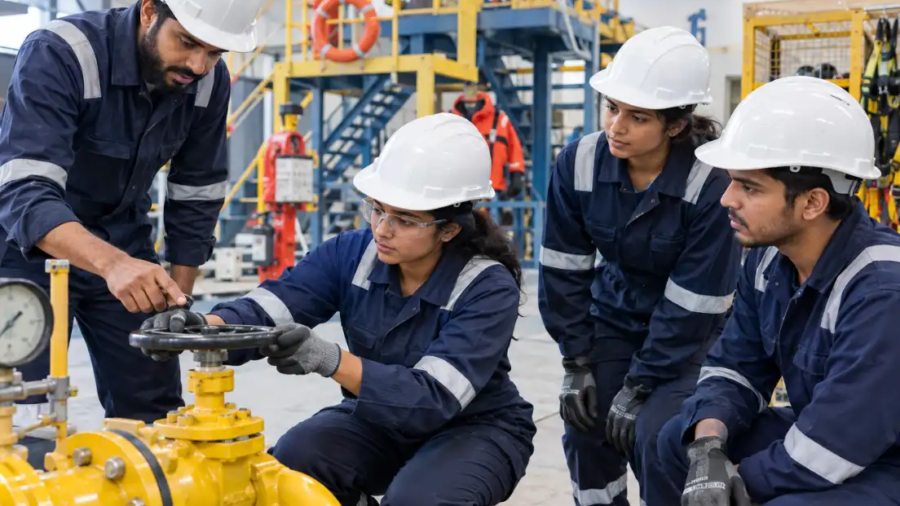

Offshore Jobs training and safety practice in Kerala

Offshore Jobs in Kerala: A Complete Beginner’s Guide

If you grew up near Kerala’s coast, you’ve probably heard someone talk about “going offshore.” Maybe it was an uncle who worked on a rig near Mumbai High. Or a neighbour who spent years on a ship in the Gulf. Or a friend who came back with stories from a platform. Offshore jobs have become a popular career choice for young people in Kerala. The pay is good. The work is different from a normal desk job. And Kerala now has good training options to help people get started. But you can’t just walk into an offshore job. There are rules to follow, certificates to get and a proper timeline to plan. This guide explains what offshore jobs really are, what Kerala offers and how a complete beginner can start.

Why Kerala Has Become an Offshore Talent Hub

Kerala has always had a strong link with the sea. For generations, the state has given India many sailors, fishermen and port workers. This makes offshore work feel familiar to many people here. Add to this a large number of ITI and diploma holders, along with engineering graduates looking for something beyond IT or nursing jobs and you get a workforce that’s ready for offshore careers. There’s another reason too. Kochi and Kozhikode are well connected to major crew-change hubs. Many training centres in Kerala now offer globally recognised courses. You no longer need to move to Mumbai, Chennai, or Dubai just to get trained. A few years back, someone from Malabar had to travel out of state for basic safety training. That has changed.

What Counts as an “Offshore Job,” Exactly

People often use the term “offshore job” for anything related to rigs. But it actually covers many different roles:

Rig and platform jobs – roughnecks, roustabouts, derrickmen and drillers who work on the drilling floor. These jobs need physical strength, but they offer good growth if you stay in the field.

Fire and safety jobs – every offshore site needs safety officers, fire watch staff and HSE (Health, Safety and Environment) workers. This is one of the easier paths for beginners, since it doesn’t always need years of mechanical experience.

QA/QC inspectors – these are people who check welds, materials and equipment to make sure they meet safety standards.

NDT technicians – non-destructive testing experts who use methods like ultrasonic testing and radiography to check for damage without breaking the equipment. NDT jobs are always in demand, since rigs and pipelines need regular checking.

Marine and support crew – people who work on supply boats, tugs and crew boats that serve the rigs.

Each of these jobs needs different training. That’s the first mistake beginners make, they think “offshore job” means just one path, when it actually means many.

Basic Eligibility: What You Need Before You Apply

Most offshore companies look for the same basic things, no matter which job you want:

  • You must be at least 18 years old (most companies prefer 19–20 or above for physical rig work)
  • A valid passport, since most jobs involve international waters or offshore sites outside India
  • A medical fitness certificate from an approved offshore doctor — this is very important and stops many candidates who skip it
  • Basic Safety Training or STCW certification (this covers survival skills, firefighting, first aid and safety awareness)
  • For technical roles like NDT or QA/QC, you also need a related diploma or degree, plus specific certification (like ASNT levels for NDT)

None of this happens in a day. That’s why proper training matters more than trying to figure things out on your own from random videos or posts online.

How to Actually Start: A Simple Path for Beginners

Step 1: Choose your path. Decide what interests you. Hands-on rig work, fire and safety or technical inspection work like NDT and QA/QC. Think about your education and how comfortable you are with physical work.

Step 2: Complete basic safety training first. Even for technical jobs, you almost always need basic offshore safety certification. This step also helps you check early if offshore life suits you.

Step 3: Pick a course that matches your chosen job. Many beginners waste money on generic courses that don’t actually help them get hired. If fire and safety interests you, go for a proper fire and safety course in calicut instead of a short workshop. If you want a technical role, an ndt level ii course in Kerala  or a qa and qc course in kerala gives you the exact certificates recruiters look for.

Step 4: Get your documents ready early. Passport, medical certificate and training certificates should all be ready before you start applying. Don’t wait until you get a call.

Step 5: Apply through manning agencies and company job postings. Most offshore hiring in India happens through approved manning agencies. Keep your certificates updated and be ready to travel for interviews or medical checks at short notice.

What Training Actually Gives You (Beyond the Certificate)

Beginners often ask if the course really matters or if it’s just about getting the certificate. The truth is, both matter. The certificate helps you pass the first screening. But the quality of your training shows later in interviews, during your first rig induction and in how fast you adjust once you’re actually working there. This is something we focus on closely at the best oil and gas institute in kerala, Rig Offshore Academy in Kozhikode. Instead of treating courses as just a formality, we focus on real, hands-on learning. Mock drills, equipment practice and real-life scenarios along with the theory needed for certification. For someone with no offshore background, this kind of training makes a big difference once they’re standing on a real platform for the first time.

Common Myths That Confuse Beginners

“You need an engineering degree for any offshore job.” Not true. Fire and safety, along with several support roles, are open to ITI holders and even non-technical graduates with the right certificate.

“Offshore work is only for men.” This is changing. More women are now working in QA/QC, NDT and support roles, both offshore and onshore.

“One certificate lasts forever.” Most offshore certificates need renewal after some time. Letting them expire is one of the most common reasons candidates lose out on jobs.

“Agencies will train you for free once selected.” Some do offer basic induction, but certificates like STCW, medical fitness and job-specific training are almost always your own responsibility beforehand.

Salary Expectations

Offshore pay depends on the job, your experience and whether it’s a domestic project (like ONGC) or an international one. Entry-level rig and safety jobs usually start with moderate pay, but it grows fast with experience and extra certificates. Technical roles like NDT and QA/QC often pay more once you build experience. Instead of focusing only on the starting salary, it’s smarter to focus on getting the right certificates first. In this field, pay usually follows skill and experience more directly than in many other industries.

Conclusion

Offshore work is not a shortcut to easy money and it’s not only for a special few people either. It’s a career with a clear path, the right basic training, the right certificate for your chosen job and the will to keep learning as you grow. With more training centres now available in Kerala, including here in Kozhikode, beginners don’t need to leave the state to get started. If you’re serious about an offshore career, the smartest step is to choose a course that matches the job you actually want, instead of collecting random certificates without a clear plan.

Fire and safety career professional inspecting an industrial site.

Fire and Safety Career Guide: Roles, Responsibilities and Growth

Every industrial plant, refinery, offshore rig and construction site runs on one unspoken rule: nothing gets built, drilled, or shipped without someone watching for fire risk. That someone is a fire and safety professional and behind almost every major accident report you’ll ever read, the difference between a close call and a tragedy usually comes down to whether trained fire and safety personnel were on site and doing their job properly. If you’re weighing a fire and safety career, this guide walks through what the work actually involves, the roles you can grow into, the skills employers look for and where the career can realistically take you over ten or fifteen years.

Why Fire and Safety Has Become a Serious Career Path

A decade ago, fire and safety was often treated as a side function, a certificate tucked alongside a mechanical or electrical qualification. That’s changed. Insurance companies now demand documented safety compliance before covering industrial sites. Government regulations around occupational health have tightened across sectors. And global oil, gas and petrochemical companies won’t even shortlist a contractor without a dedicated safety team on the payroll. This shift has turned fire and safety into a standalone profession with its own certification ladder, its own salary bands and its own long-term career track not just in India, but across the Gulf, Southeast Asia and Europe, where Indian-trained safety officers are in steady demand.

What a Fire and Safety Career Actually Involves

At its core, the job is about prevention, preparedness and response. That breaks down into a few concrete areas of daily work:

Risk assessment and inspection. Walking a site, identifying fire hazards, faulty wiring, poor ventilation, flammable storage, blocked exits and documenting them before they cause an incident.

Equipment maintenance and compliance. Fire extinguishers, hydrant systems, sprinklers and alarm panels don’t maintain themselves. Someone has to test them on schedule and keep the paperwork audit-ready.

Emergency response planning. Drawing up evacuation routes, running mock drills and training staff who have never handled a fire extinguisher in their life to do it correctly under pressure.

Training and awareness. A large part of the role is teaching inducting new workers, refreshing existing staff and making sure safety isn’t just a poster on the wall.

Incident investigation. When something does go wrong, fire and safety officers are the ones who reconstruct what happened and recommend changes so it doesn’t happen again.

Key Roles in a Fire and Safety Career

The field isn’t a single job title, it’s a ladder with several distinct positions, each with a different scope of responsibility.

Fire and Safety Officer – the entry point for most graduates. Responsible for day-to-day inspections, drills and basic compliance documentation at a single site.

Fire and Safety Supervisor – oversees a team of officers, coordinates with plant or site management and handles incident reporting at a higher level.

Fire Safety Engineer – a more technical role, often requiring engineering knowledge, focused on designing fire suppression systems, building layouts and equipment specifications rather than day-to-day patrolling.

HSE Officer (Health, Safety and Environment) – a broader role that folds fire safety into a wider mandate covering occupational health and environmental compliance, common in oil and gas and manufacturing.

Offshore Fire and Safety Technician – specific to oil rigs and offshore platforms, where the stakes and the pay both scale up considerably due to the isolated, high-risk working environment.

As you move up this ladder, the work shifts from hands-on inspection toward planning, auditing and training others which is where the real salary growth tends to happen.

Skills That Actually Matter on the Job

Certificates get you an interview; these skills get you hired and promoted:

  • Sharp observation – spotting a hazard that’s been sitting in plain sight for months
  • Calm decision-making under pressure, since real emergencies rarely follow the drill script
  • Working knowledge of fire codes and standards (NFPA, OISD and local statutory regulations depending on the sector)
  • Basic technical literacy – reading electrical layouts, piping diagrams and building plans
  • Clear communication, since a large chunk of the role involves training people who’d rather be doing anything else

Employers in oil and gas particularly value candidates who understand adjacent disciplines too. It’s common to see fire and safety professionals cross-train in quality control, since sites often expect one person to wear both hats. That overlap is why many students pair their fire and safety certification with a QA QC course, it widens the job pool considerably without adding years to the study.

Where the Jobs Actually Are

Fire and safety isn’t confined to fire stations. The bulk of hiring happens in:

  • Oil refineries and petrochemical plants
  • Offshore drilling platforms and FPSOs
  • Manufacturing and heavy industrial units
  • Construction and infrastructure projects
  • Ports, shipyards and marine terminals
  • Commercial buildings and hospitals (facilities management)

Oil and gas remains the single biggest recruiter, largely because the consequences of a fire on a rig or at a refinery are so severe that companies staff up rather than take shortcuts. This is also why so many students entering fire and safety end up exploring the wider oil and gas course in Kerala alongside it, since the two fields hire from overlapping talent pools and often share the same clients.

Career Growth: What the Next Ten Years Can Look Like

A typical progression runs something like this: Fire and Safety Officer for two to three years, building hands-on site experience, followed by a move into a Supervisor role once you’ve handled a few real incidents and audits without incident. From there, the path splits, some go technical and move toward Fire Safety Engineering or system design, while others go managerial, eventually landing HSE Manager or Site Safety Manager positions overseeing entire facilities.

Offshore roles tend to accelerate this timeline financially, if not always in title, since offshore postings pay a premium for the isolation and risk involved. It’s also worth noting that safety professionals with additional technical certifications particularly in non-destructive testing tend to get pulled into higher-paying inspection and audit roles faster than generalists. That’s part of why an NDT Level II course in Kerala is a common add-on for safety professionals looking to specialize rather than stay generalist for their whole career. International postings, particularly in the Gulf, Singapore and parts of West Africa, remain a major draw for experienced Indian fire and safety professionals and Kerala continues to supply a disproportionate share of that workforce given the state’s long history of sending skilled manpower into the offshore and marine sectors.

Where to Train: Why Location and Institute Choice Matters

Not every safety certification carries the same weight with employers. Recruiters in oil and gas specifically look for training that includes practical drills, live fire exposure under controlled conditions and instructors with actual industry background rather than classroom-only teaching.

This is where Rig Offshore Academy in Kozhikode has built its reputation, training built around real industry expectations rather than a checklist of theory classes. For students based in North Kerala, a fire and safety course in Calicut, at the academy gives you the certification employers recognize, without needing to relocate to Kochi or Chennai for training that’s available closer to home. The institute’s broader catalog, spanning everything from a oil and gas diploma courses in Kerala to specialized QA/QC and NDT programs  also means students can stack complementary certifications under one roof rather than piecing together training from multiple providers. For anyone comparing options, it’s worth checking how a program ranks among the wider field of best oil and gas institute in Kerala options before committing, since placement support and industry tie-ups vary a lot more between institutes than the course syllabus does.

Conclusion

A fire and safety career isn’t a fallback option anymore. It’s a legitimate, well-paying profession with real progression, strong demand in oil and gas and offshore sectors and genuine international mobility for anyone willing to build the right certifications. The entry point is straightforward: get certified, get hands-on training and choose an institute that trains you the way employers actually expect, not just the way a syllabus requires. From there, the roles, responsibilities and pay scale up steadily for anyone who takes the work seriously. If you’re based in Kerala and considering where to start, look closely at what a local institute offers beyond the certificate, practical training, industry placements and the option to add complementary skills as your career develops.

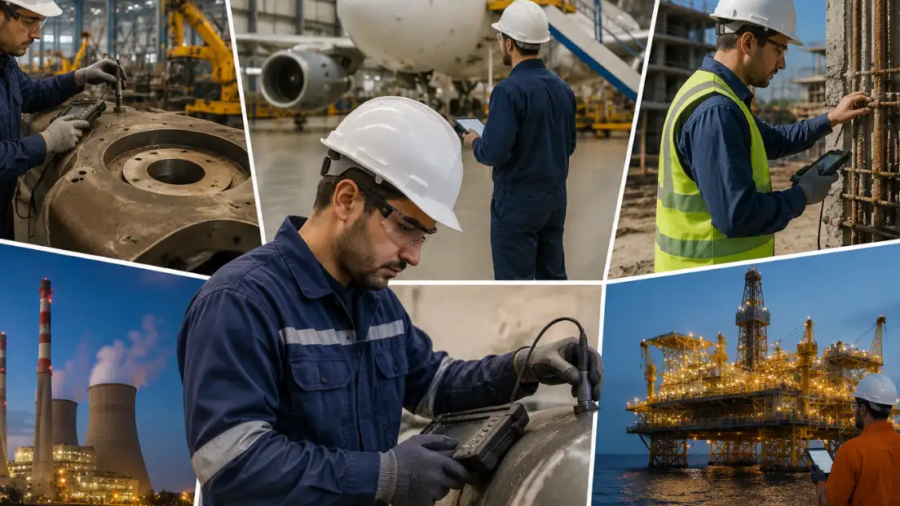
NDT technicians inspecting industrial equipment.

5 Industries That Are Actively Hiring NDT Technicians

Non-Destructive Testing (NDT) isn’t a niche skill anymore. It’s become one of the more dependable technical careers out there, mostly because the work it does is impossible to skip. Pipelines, aircraft parts, pressure vessels, steel structures anything that could fail catastrophically has to be checked without being cut open or damaged in the process. That’s the whole job of an NDT technician and right now, a surprising number of industries are competing for people who can do it well. There’s also a practical reason this matters right now. A lot of people assume NDT is a one-industry skill, tied purely to oil and gas. That’s not really true anymore. Regulations around structural safety have tightened across nearly every sector that deals with heavy machinery or load-bearing structures and the technicians trained to spot problems early are in demand well beyond rigs and pipelines.

If you’re trying to figure out where this skill set actually leads, here are five industries hiring NDT technicians at a steady pace and why each one is worth a serious look.

1. Oil and Gas

This is the industry most people think of first and honestly, it earns that reputation. Offshore platforms, refineries, storage tanks all of it runs under extreme pressure, in corrosive, high-vibration environments where a hairline crack in a weld can turn into a major shutdown or worse. Ultrasonic testing, radiographic testing, magnetic particle inspection, technicians here rotate through all of it depending on what needs checking.

Offshore work specifically tends to demand technicians who understand more than just the testing side. Saltwater corrosion alone creates constant wear on equipment, so a lot of professionals end up pairing their NDT certification with an oil and gas diploma just to get a fuller picture of the rig environment they’re inspecting not only the flaw they’re looking for but why it’s forming in the first place.

Onshore refineries hire just as steadily, often around scheduled “turnarounds,” where a whole processing unit shuts down for a short window purely for inspection and maintenance. Those windows are short, intense and well paid. A good example of how the demand in this sector isn’t just one steady stream, it comes in bursts too.

2. Aerospace Manufacturing

Nowhere is precision taken more seriously than in aerospace. A missed defect in a turbine blade or a fuselage weld isn’t a minor issue, it’s a safety failure waiting to happen. That’s why aircraft manufacturers lean so heavily on eddy current testing and radiography and why the technicians doing that work are held to an unusually tight standard. What’s interesting about aerospace is that the demand doesn’t stop once a plane rolls out of the factory. Every aircraft in commercial service goes through recurring structural checks for its entire operating life, which means MRO (maintenance, repair and overhaul) facilities need technicians just as much as manufacturers do. In a lot of ways, this overlaps with how QA/QC teams operate in oil and gas both roles exist to catch a problem before it becomes someone else’s emergency.

3. Automotive and Heavy Manufacturing

As cars get more complex especially with EVs and hybrid drivetrains entering the mix, manufacturers are relying more on NDT to catch flaws in castings and welds before a vehicle ever leaves the factory floor. It’s a different rhythm of work compared to oil and gas or aerospace: mostly factory-based, more predictable hours, less field travel. That predictability is actually a selling point for a lot of technicians. And as automakers adopt automated inspection systems alongside traditional methods, there’s growing demand for people who can work comfortably with both, someone who understands the fundamentals of testing but isn’t intimidated by the newer digital tools showing up on production lines.

4. Construction and Infrastructure

Bridges, high-rises, dams none of these get built (or maintained) without structural checks that go well beyond a visual walk-through. NDT technicians here test welds on steel frameworks, check concrete reinforcement and confirm load-bearing components actually meet code, both during construction and years afterward. A lot of older infrastructure is legally required to undergo periodic re-testing, which creates fairly consistent inspection contracts regardless of how much new construction is happening in a given year. It’s also one of the more accessible entry points for someone early in their career, since construction sites often need technicians comfortable with a mix of testing types and there’s some natural crossover here with fire and safety inspection work too, given how tightly structural integrity and fire compliance are linked in large buildings.

5. Power Generation

Thermal plants, nuclear facilities, renewable energy sites all of them depend on inspection cycles that are non-negotiable. Boilers, turbines and pressure piping operate under extreme heat and stress and an undetected flaw here doesn’t just mean downtime, it can mean a serious safety incident. Power plants typically schedule shutdowns specifically for inspection and maintenance and NDT technicians are central to that process every time. What makes this sector particularly stable is that these inspection cycles are mandated by regulation, not left up to a company’s discretion, so the work tends to hold steady even when the broader economy slows down. As more renewable energy projects come online too, that’s opening up a slightly different flavor of inspection work testing welds on wind turbine towers or solar structural mounts, for instance which means the sector isn’t just thermal and nuclear anymore, it’s expanding in newer directions as well.

What Employers Are Actually Looking For

Across all five industries, the baseline skill set doesn’t change much: ultrasonic testing, radiographic testing, magnetic particle inspection, dye penetrant testing, eddy current testing. Most candidates coming out of a certification program know the theory. What separates the ones who actually get hired is hands-on repetition, enough practice to read results correctly under real working conditions, not just in a controlled classroom setup. Employers also tend to notice technicians who understand the bigger picture, how a missed defect could ripple into a production delay, a safety violation or a much bigger repair bill down the line. That kind of judgment usually comes from training that’s grounded in real industry scenarios, not just textbook procedure.

Why NDT Still Makes Sense as a Career

What ties these five industries together is pretty simple: safety regulations aren’t loosening and aging infrastructure isn’t getting any younger. Both point toward demand that isn’t going away anytime soon. And unlike a lot of technical roles being chipped away by automation, NDT still needs a trained person to interpret what the equipment is showing which keeps the human element firmly in the loop, even as the tools get more advanced.

For anyone in Kerala looking to break into this field, certification is the obvious starting point. A proper NDT Level II course in Kerala gives you working exposure across multiple testing methods which matters more than it sounds. It’s what keeps your options open across industries instead of boxing you into just one.

Conclusion

NDT technicians aren’t confined to a single corner of the industrial world anymore. They’re needed wherever structural safety actually matters, from offshore rigs to aircraft hangars to power stations. That range is really the appeal of this career: the skills carry over and the demand doesn’t hinge on one industry’s ups and downs. At Rig Offshore Academy, training students for exactly that kind of multi-industry readiness has been the focus with an emphasis on the practical, hands-on skills that employers actually check for, not just the ones listed on a certificate. If you’re serious about building a career in NDT, a structured, industry-relevant program is still the most reliable way to get there.