
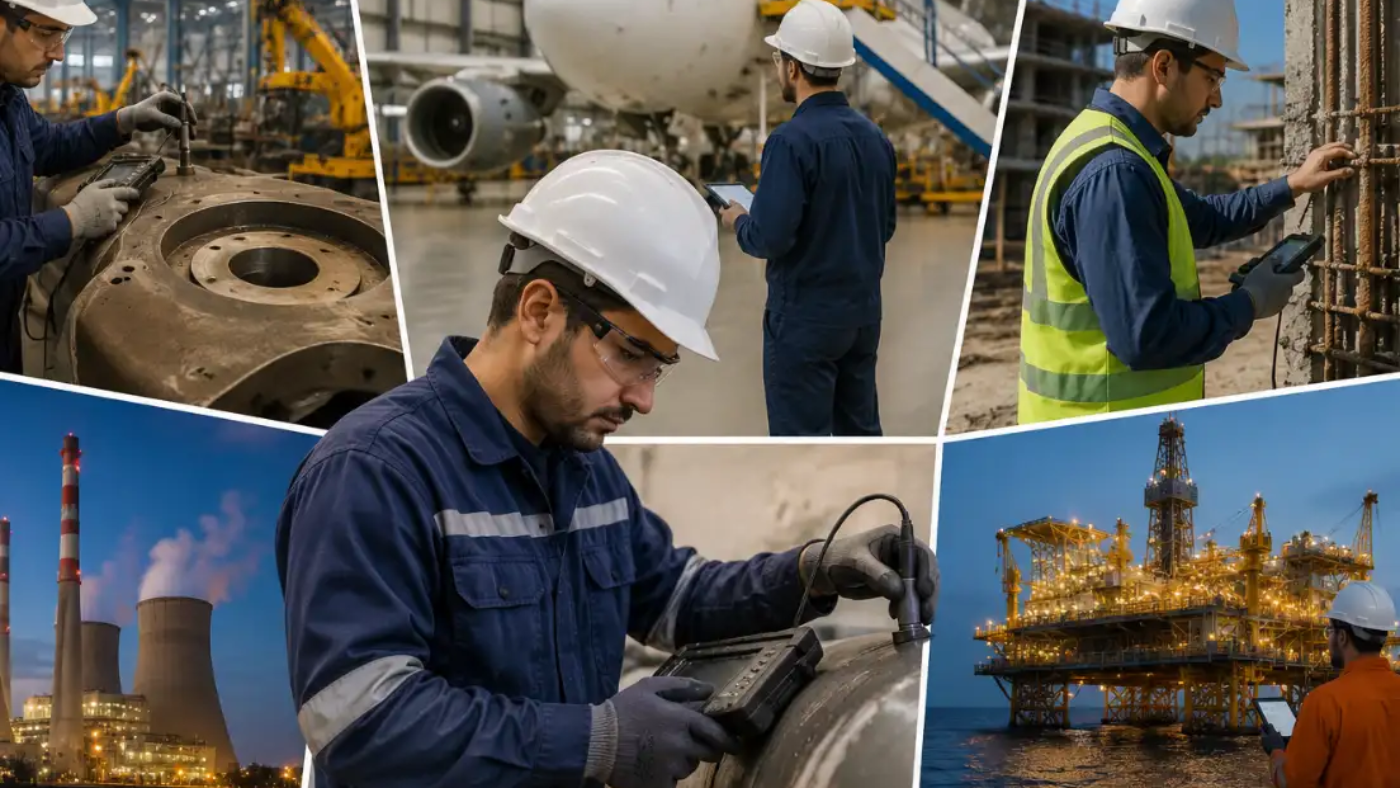
Non-Destructive Testing (NDT) isn’t a niche skill anymore. It’s become one of the more dependable technical careers out there, mostly because the work it does is impossible to skip. Pipelines, aircraft parts, pressure vessels, steel structures anything that could fail catastrophically has to be checked without being cut open or damaged in the process. That’s the whole job of an NDT technician and right now, a surprising number of industries are competing for people who can do it well. There’s also a practical reason this matters right now. A lot of people assume NDT is a one-industry skill, tied purely to oil and gas. That’s not really true anymore. Regulations around structural safety have tightened across nearly every sector that deals with heavy machinery or load-bearing structures and the technicians trained to spot problems early are in demand well beyond rigs and pipelines.
If you’re trying to figure out where this skill set actually leads, here are five industries hiring NDT technicians at a steady pace and why each one is worth a serious look.
1. Oil and Gas
This is the industry most people think of first and honestly, it earns that reputation. Offshore platforms, refineries, storage tanks all of it runs under extreme pressure, in corrosive, high-vibration environments where a hairline crack in a weld can turn into a major shutdown or worse. Ultrasonic testing, radiographic testing, magnetic particle inspection, technicians here rotate through all of it depending on what needs checking.
Offshore work specifically tends to demand technicians who understand more than just the testing side. Saltwater corrosion alone creates constant wear on equipment, so a lot of professionals end up pairing their NDT certification with an oil and gas diploma just to get a fuller picture of the rig environment they’re inspecting not only the flaw they’re looking for but why it’s forming in the first place.
Onshore refineries hire just as steadily, often around scheduled “turnarounds,” where a whole processing unit shuts down for a short window purely for inspection and maintenance. Those windows are short, intense and well paid. A good example of how the demand in this sector isn’t just one steady stream, it comes in bursts too.
2. Aerospace Manufacturing
Nowhere is precision taken more seriously than in aerospace. A missed defect in a turbine blade or a fuselage weld isn’t a minor issue, it’s a safety failure waiting to happen. That’s why aircraft manufacturers lean so heavily on eddy current testing and radiography and why the technicians doing that work are held to an unusually tight standard. What’s interesting about aerospace is that the demand doesn’t stop once a plane rolls out of the factory. Every aircraft in commercial service goes through recurring structural checks for its entire operating life, which means MRO (maintenance, repair and overhaul) facilities need technicians just as much as manufacturers do. In a lot of ways, this overlaps with how QA/QC teams operate in oil and gas both roles exist to catch a problem before it becomes someone else’s emergency.
3. Automotive and Heavy Manufacturing
As cars get more complex especially with EVs and hybrid drivetrains entering the mix, manufacturers are relying more on NDT to catch flaws in castings and welds before a vehicle ever leaves the factory floor. It’s a different rhythm of work compared to oil and gas or aerospace: mostly factory-based, more predictable hours, less field travel. That predictability is actually a selling point for a lot of technicians. And as automakers adopt automated inspection systems alongside traditional methods, there’s growing demand for people who can work comfortably with both, someone who understands the fundamentals of testing but isn’t intimidated by the newer digital tools showing up on production lines.
4. Construction and Infrastructure
Bridges, high-rises, dams none of these get built (or maintained) without structural checks that go well beyond a visual walk-through. NDT technicians here test welds on steel frameworks, check concrete reinforcement and confirm load-bearing components actually meet code, both during construction and years afterward. A lot of older infrastructure is legally required to undergo periodic re-testing, which creates fairly consistent inspection contracts regardless of how much new construction is happening in a given year. It’s also one of the more accessible entry points for someone early in their career, since construction sites often need technicians comfortable with a mix of testing types and there’s some natural crossover here with fire and safety inspection work too, given how tightly structural integrity and fire compliance are linked in large buildings.
5. Power Generation
Thermal plants, nuclear facilities, renewable energy sites all of them depend on inspection cycles that are non-negotiable. Boilers, turbines and pressure piping operate under extreme heat and stress and an undetected flaw here doesn’t just mean downtime, it can mean a serious safety incident. Power plants typically schedule shutdowns specifically for inspection and maintenance and NDT technicians are central to that process every time. What makes this sector particularly stable is that these inspection cycles are mandated by regulation, not left up to a company’s discretion, so the work tends to hold steady even when the broader economy slows down. As more renewable energy projects come online too, that’s opening up a slightly different flavor of inspection work testing welds on wind turbine towers or solar structural mounts, for instance which means the sector isn’t just thermal and nuclear anymore, it’s expanding in newer directions as well.
What Employers Are Actually Looking For
Across all five industries, the baseline skill set doesn’t change much: ultrasonic testing, radiographic testing, magnetic particle inspection, dye penetrant testing, eddy current testing. Most candidates coming out of a certification program know the theory. What separates the ones who actually get hired is hands-on repetition, enough practice to read results correctly under real working conditions, not just in a controlled classroom setup. Employers also tend to notice technicians who understand the bigger picture, how a missed defect could ripple into a production delay, a safety violation or a much bigger repair bill down the line. That kind of judgment usually comes from training that’s grounded in real industry scenarios, not just textbook procedure.
Why NDT Still Makes Sense as a Career
What ties these five industries together is pretty simple: safety regulations aren’t loosening and aging infrastructure isn’t getting any younger. Both point toward demand that isn’t going away anytime soon. And unlike a lot of technical roles being chipped away by automation, NDT still needs a trained person to interpret what the equipment is showing which keeps the human element firmly in the loop, even as the tools get more advanced.
For anyone in Kerala looking to break into this field, certification is the obvious starting point. A proper NDT Level II course in Kerala gives you working exposure across multiple testing methods which matters more than it sounds. It’s what keeps your options open across industries instead of boxing you into just one.
Conclusion
NDT technicians aren’t confined to a single corner of the industrial world anymore. They’re needed wherever structural safety actually matters, from offshore rigs to aircraft hangars to power stations. That range is really the appeal of this career: the skills carry over and the demand doesn’t hinge on one industry’s ups and downs. At Rig Offshore Academy, training students for exactly that kind of multi-industry readiness has been the focus with an emphasis on the practical, hands-on skills that employers actually check for, not just the ones listed on a certificate. If you’re serious about building a career in NDT, a structured, industry-relevant program is still the most reliable way to get there.
Leave A Comment