
Ask a Plus Two student in Kozhikode what NDT means and most will shrug. Ask a plant manager in Abu Dhabi what happens when a weld on a pressure vessel cracks and he will tell you exactly why the field exists. Non-destructive testing sits quietly behind almost every pipeline, refinery, ship and bridge and the people who do it are paid to find problems before those problems find everyone else. If you are weighing an NDT career in 2026, you probably want straight answers. How much does it pay? Is there steady work? Can a fresher really move up? This guide covers all three in plain terms.
What NDT Actually Means
NDT stands for non-destructive testing. The idea is simple: check a material, a weld or a part for hidden defects without cutting it open or damaging it. A pipe that has been sliced apart for inspection is useless afterwards. A pipe checked with an ultrasonic probe is still a pipe.
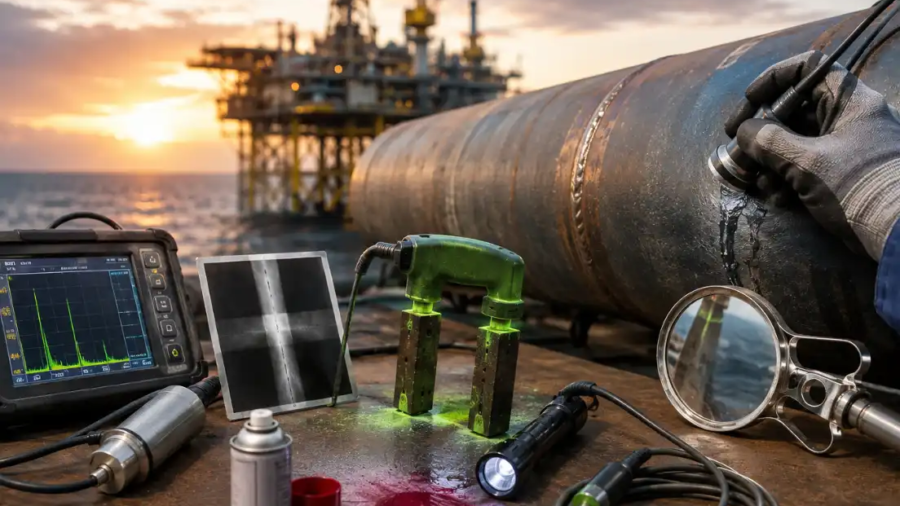
Five methods cover most of the work:
- Radiographic testing (RT) uses X-rays or gamma rays to produce an image of a weld, much like a medical X-ray.
- Ultrasonic testing (UT) sends sound waves into metal and reads the echoes to find cracks and thickness loss.
- Magnetic particle testing (MT) shows surface and near-surface cracks in magnetic metals.
- Liquid penetrant testing (PT) uses dye to reveal cracks that reach the surface.
- Visual testing (VT) is trained inspection with the eyes and simple gauges.
Employers usually hire for UT, RT, MT and PT first, since those are the methods used on welds and pipelines.
What an NDT Technician Does All Day
The job is more physical than most people expect. A technician might spend the morning on a scaffold checking weld joints on a pipe rack, then spend the afternoon in a dark room reading radiographic film. During shutdowns, when a plant stops for maintenance, twelve-hour shifts can run for weeks. The paperwork matters as much as the testing. Every finding has to be recorded clearly, because an inspector or a client will rely on that report to decide whether a part stays in service. Careful, honest reporting is what separates a trusted technician from a risky one.
NDT Career Pay in India and the Gulf
Pay is the part everyone asks about. The figures below are rough ranges seen in job adverts and shared by working technicians. They shift with the employer, the site, your certifications and the methods you hold, so treat them as a guide and not a promise.
In India, a trainee or Level 1 technician usually starts somewhere around ₹12,000 to ₹20,000 a month. Once you reach Level 2, that often moves to roughly ₹20,000 to ₹40,000. Level 3 specialists and senior inspectors can cross ₹60,000 and some go well beyond that.
The Gulf pays more at every step. A trainee or Level 1 technician might see around AED 1,200 to 2,000 a month, while a Level 2 technician commonly earns about AED 2,500 to 5,000. Level 3 professionals can reach AED 8,000 and above.
A few things push these numbers up. Holding more than one method makes you cheaper to hire than two separate specialists, so employers pay for it. Offshore and shutdown work adds overtime. Gulf packages often include accommodation, transport and an annual flight, so what you save can be higher than the salary alone suggests.
Always compare the full package and not just the headline figure and check the current numbers on live job listings before you plan around them.
Scope: Where the Work Is
Almost any industry that builds with metal needs testing. The big employers are:
- Oil and gas, including refineries, pipelines and offshore platforms
- Petrochemical and power plants
- Shipbuilding and ship repair
- Fabrication and construction yards
- Aviation maintenance
Demand holds up for a reason that has little to do with new projects. Old plants, tanks and pipelines have to be inspected on a schedule and many codes make that testing compulsory. Even when no one is building anything new, the existing infrastructure still ages. New tools are arriving too, such as phased array ultrasonics and drone-assisted inspection. They change how the work is done, but a certified person still has to interpret the results and sign the report. To be fair, the field is not immune to cycles. When oil prices fall, hiring in oil and gas slows. People who hold certifications for several methods and can work across industries ride those dips out far better. If the Gulf is your target, our guide to offshore jobs in Kerala explains how the hiring side works for freshers.
Growth: From Level 1 to Level 3
NDT has a clear ladder, which is one of its biggest strengths as a career.
Level 1 technicians carry out tests under supervision and follow written instructions. This is where most freshers begin.
Level 2 technicians can set up and calibrate equipment, carry out tests on their own, interpret results against codes and write the reports. This is the level most employers actually want on site and it is where pay moves noticeably.
Level 3 specialists write procedures, approve techniques, train others and examine candidates. They are few and they are paid accordingly.
Certification usually comes through schemes such as ASNT SNT-TC-1A, which is employer-based or through ISO 9712 and PCN, which are independent. The training hours and on-the-job experience needed depend on the scheme and the method, so confirm the exact requirement before you enrol anywhere. Many technicians also branch out. With a few years of experience, NDT people often move into welding inspection, supervision or full QA/QC roles, where inspection knowledge is the main qualification. Others build a freelance or consulting practice later.
Is an NDT Career Right for You?
It tends to suit people who:
- Are patient and notice small details
- Can work in heat, dust, confined spaces or at height
- Are comfortable with shift work and time away from home
- Take reporting seriously, since a wrong signature can have real consequences
It is not a good fit if you dislike field work or want a desk job from day one. Safety also deserves respect, particularly with radiography, where radiation rules are strict. A basic grounding in site safety helps in any NDT job and a short fire and safety diploma is a common companion qualification.
Getting Started
You do not need an engineering degree to enter this field. Most people begin after Plus Two, ITI or a mechanical or related diploma, then complete structured training and gain site hours. Training quality matters a great deal here, because employers can tell the difference between someone who has read about UT and someone who has held a probe. Whichever institute you pick, ask three things: how many practical hours you will get, which certification body the course follows and what support exists for job placement.
The best oil and gas institute in kerala, Rig Offshore Academy in Kozhikode trains students for this exact route through its NDT Level 2 programme. The institute also runs QA/QC, Fire and Safety and an Oil and Gas Diploma, so students can add a second skill when their plans change. You can see everything on offer on the Rig Offshore Academy page and if safety is the career you lean toward, our fire and safety career guide is worth reading next.
Conclusion
An NDT career offers something many entry-level paths do not: a visible ladder, skills that travel between industries and countries and demand that comes from rules and ageing equipment, not just new construction. Pay starts modestly in India, climbs sharply at Level 2 and goes further once Gulf packages are included. The cost is physical work, shift schedules and a real responsibility to report honestly. If that trade-off sounds acceptable, the best next step is practical training that leads to a recognised certification. Check the current salary figures against live job listings, ask hard questions of any institute you consider and start building site-ready skills early. Done well, NDT can turn a Plus Two certificate or a diploma into a career that lasts decades.