If you’ve ever asked someone who works offshore what the job is actually like, you probably got a version of the same answer. Long hours. Tough conditions. Not for everyone. And honestly, there’s truth in that. But there’s also a fair bit of exaggeration mixed in, plus a lot that people simply get wrong because they’ve never seen a platform up close. So let’s break it down properly. How physically demanding is offshore work? It depends a lot on the role you’re in, but almost every job out there will ask more of your body than a regular nine-to-five. The good news is that most of it can be prepared for and knowing what’s coming makes a real difference once you’re actually out there.
It’s Not Just Lifting Heavy Things
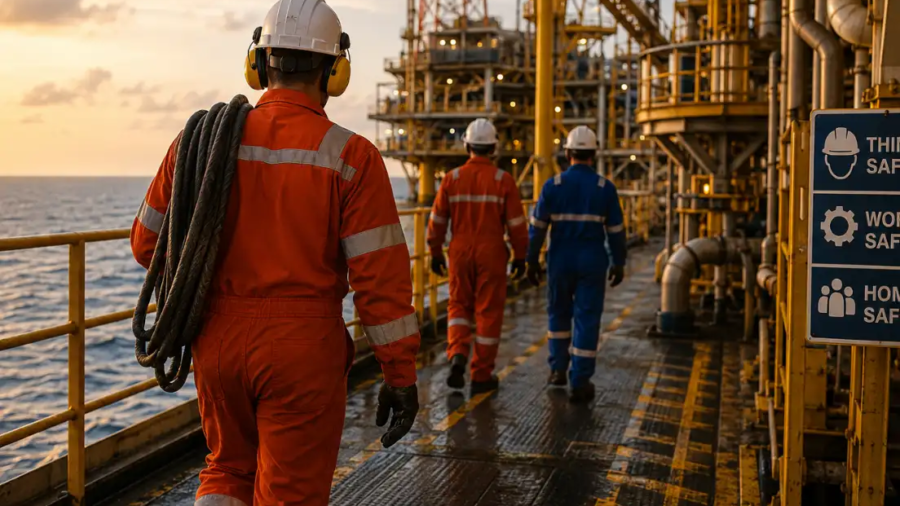
Most people picture offshore work as someone dragging pipes around in the heat for twelve hours. That does happen, but it’s a narrow slice of what actually goes on. A platform runs on a lot of different roles and each one puts a different kind of strain on the body. Deck crew and riggers are on their feet for most of the shift, moving loads and working with cranes in conditions that can shift within the hour. Inspection technicians, the ones doing welding checks, corrosion assessments or NDT work, often end up in awkward postures for long stretches. Think crouched inside a tank, reaching into a tight space or balancing on scaffolding to get a proper look at a weld. QA/QC staff walk far more than people expect too. Verifying work against documentation means constant movement, not sitting at a desk with a checklist. Even the roles considered less physical still involve heat, noise and the general fatigue of a marine environment that never quite sits still. The platform moves. Weather turns without much warning. And there’s no popping outside for fresh air when things get long, because offshore, you’re there until the rotation ends.
What You’re Actually Up Against
A handful of things tend to catch new offshore workers off guard.
Shift length. Twelve-hour days are the norm and they often run for two to four weeks straight before you rotate home. That’s a lot of sustained output with none of the usual weekend breaks to recover.
Weather and heat. Depending on where the platform sits, crews deal with intense sun, thick humidity or freezing cold, sometimes both within the same rotation. Add PPE on top and the heat load only gets worse.
Tight spaces. Tank entry, pipeline checks and structural inspections mean working in cramped, poorly ventilated areas, sometimes for hours at a stretch. It wears you down differently than open-deck labour does.
Constant noise. Machinery doesn’t stop. Without proper hearing protection and regular breaks, the noise alone can tire a person out faster than the physical tasks themselves.
Balance. A platform that moves changes how your body has to work. Simple things like climbing a ladder or carrying gear suddenly need more core strength and awareness than they would on solid ground.
None of this makes offshore work impossible to handle. It just means preparation matters. Fitness, technique and training that reflects real conditions rather than sticking purely to theory.
Training Is What Actually Separates People
Here’s something a lot of newcomers don’t realise until they’re already out there: it’s rarely brute strength that decides who copes well offshore. It’s usually technique, pacing and knowing how to work smart when conditions get tough. And that comes from proper training, not from figuring it out on the job. A solid fire and safety course in Kozhikode, for instance, builds the muscle memory and confidence you need when things get stressful, whether that’s during a drill or the real thing. Similarly, anyone heading into inspection work benefits massively from getting hands-on during an NDT Level II course in Calicut, where you actually practice holding positions, handling equipment and managing fatigue before doing it under real offshore pressure. QA/QC professionals aren’t exempt either, even though the role gets treated as less physical than it really is. A good QA QC course in Calicut should get you ready for the walking, standing, and on-site verification that comes with the job, not just the documentation side of things.
You Don’t Need to Be an Athlete
Nobody’s expecting you to walk onto a rig looking like a bodybuilder. What matters more is functional fitness: lifting safely, keeping your balance, handling heat without wearing out and recovering properly during rest periods. Cardio helps you get through long shifts. Core strength keeps you steady on a moving deck. Even basic flexibility cuts down on injuries during repetitive bending and reaching. Most people build this up naturally within a few months on the job, especially if they’ve started with decent foundational training instead of going in cold. It’s honestly one of the more underrated benefits of a good course before your first posting. Your body adjusts faster and you’re less likely to get hurt in that early stretch.
It Changes as You Gain Experience
The physical demand isn’t the same throughout an offshore career. New workers usually feel it most in the first year, mainly because the body is still adjusting to the shift patterns, heat and unfamiliar movements. With time, most people pick up better technique and pacing, which is a big part of why experienced hands often handle the strain better than newer, younger crew members do. It’s also why people who move into supervisory or QA/QC-heavy roles later on find the transition manageable. The physical load doesn’t go away entirely, but it shifts. Less heavy lifting, more walking, observing and coordinating across the site.
Where You Train Matters Too
If you’re in Kerala and thinking about this path, where you train counts for almost as much as what you train in. Programs built around real offshore scenarios, rather than pure classroom theory, prepare you far better for what’s coming physically and mentally. It’s part of why Rig Offshore Academy has built a name as one of the best oil and gas institutes in Kerala, blending core fundamentals with practical, hands-on training across fire and safety, NDT and QA/QC. Whether you’re just starting to look at an oil and gas course in Kerala or weighing options for an oil and gas diploma course in Kerala, it’s worth picking a program that treats physical readiness as part of the actual curriculum rather than an afterthought. Training out of Calicut also puts you in a location that’s steadily building a name for producing offshore-ready graduates, with solid placement support once the course wraps up.
Conclusion
So yes, offshore work is physically demanding and that part of its reputation holds up. But it’s not demanding in quite the way most people picture. It’s less about raw strength and more about stamina, technique and the ability to keep going steadily as conditions shift around you. All of that can be built up, given the right training and realistic expectations going in. If you’re serious about a career offshore, skip the gym membership as your first move and start with proper, practical training instead. That’s the whole idea behind Rig Offshore Academy: getting students in Kerala ready not just to clear a course, but to actually walk onto a platform and handle what the job throws at them.