Offshore oil and gas platforms rank among the toughest work environments anywhere in the world. Workers spend their shifts around flammable materials, high-pressure systems and tight, confined spaces, often stationed hundreds of kilometers from the nearest shore. Under these conditions, something as small as a spark or an overlooked leak can spiral into a genuine emergency within minutes. That’s the real reason fire and safety training holds so much weight in the oil and gas industry. it’s not a resume booster, it’s a baseline requirement for staying alive on the job. There’s a common assumption that safety training begins and ends in a classroom memorizing fire triangles, extinguisher categories and a list of dos and don’ts. That foundation matters, no doubt. But what actually gets a worker ready for a real offshore emergency goes well past textbook material. It comes down to building instinctive reactions, learning the specific risks tied to rig environments and rehearsing under conditions that come close to replicating actual chaos.
Why Offshore Fires Play by Different Rules
A fire breaking out at a land-based industrial site and one breaking out on an offshore rig aren’t remotely comparable challenges. Out on a platform, there’s no easy exit strategy, you can’t just walk out the door or drive off site. Workers are boxed in by water on all sides, frequently working at height, surrounded by pressurized gas lines, storage tanks and electrical wiring packed close together. A fire starting in one area can spread rapidly given how tightly most rigs are laid out. Throw in strong winds, cramped walkways and hydrocarbons sitting nearby and things can turn dangerous faster than most people would guess. That’s precisely why offshore fire response can’t rely on general awareness alone. It demands training built specifically around these conditions.
Building Instinct, Not Just Information
Arguably the biggest payoff from solid fire and safety training is muscle memory. When an actual emergency hits, there’s rarely time to sit and recall theory. Stress narrows a person’s focus and instinct tends to take over from there. Good training programs are designed with this exact reality in mind. Trainees run through repeated drills locating and operating firefighting gear in low visibility or blindfolded, practicing evacuation routes until the path becomes automatic, reacting to simulated alarms without a moment’s hesitation. Over time, these movements stop feeling like conscious choices and start becoming reflex. That shift is what separates a person who freezes mid-crisis from one who acts within seconds.
Knowing Fire Classes and Matching the Right Response
Fires don’t all behave the same and reaching for the wrong extinguishing method can make a bad situation worse. A fire fed by flammable liquids calls for a completely different approach than an electrical fire or one sparked by combustible metals. Training programs put real time into helping workers correctly identify fire classes and pair them with the right suppression method. On an offshore platform, where hydrocarbon fires remain a constant threat, this isn’t something learned for the sake of an exam. It’s what decides whether a fire gets contained early or spreads out of control.
Running Simulated Emergency Drills
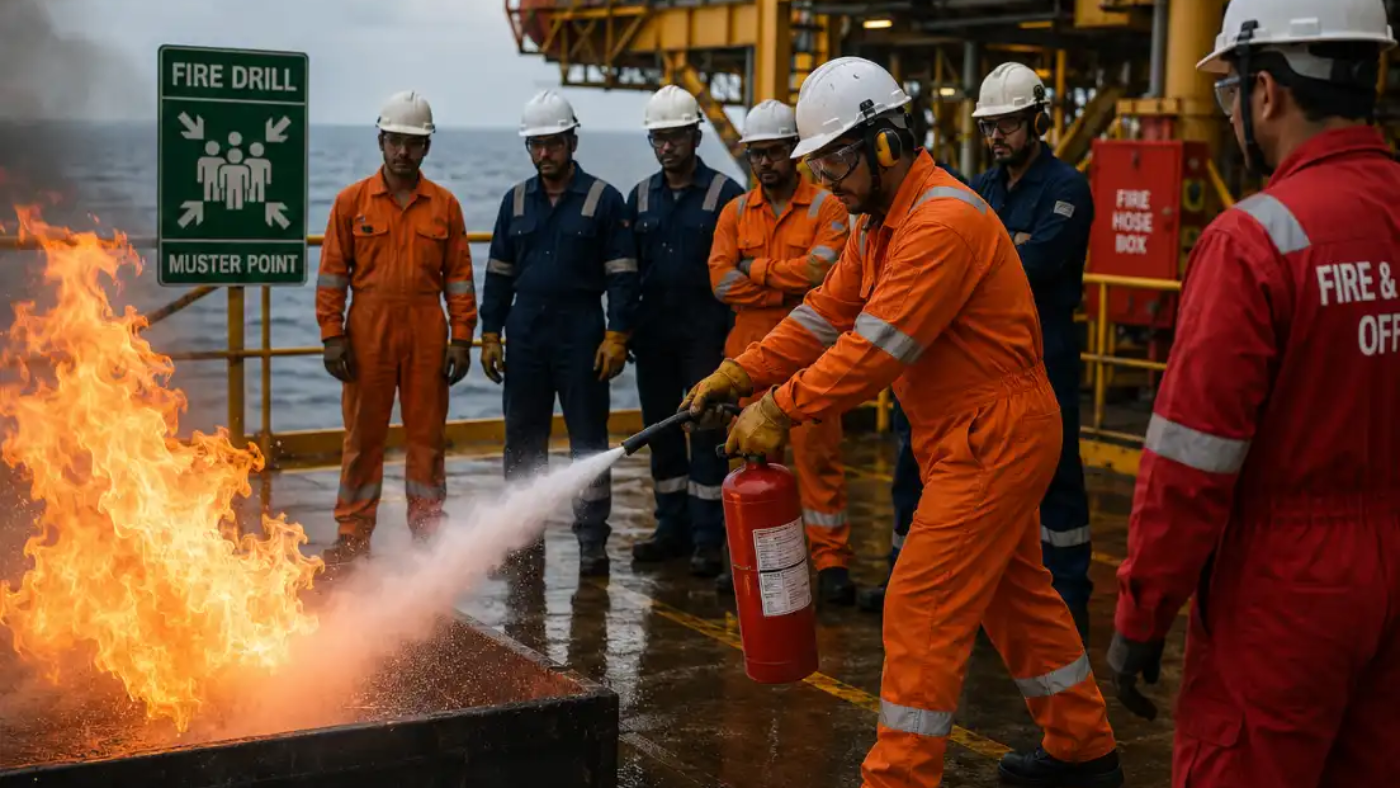
The most valuable piece of any serious fire and safety program is arguably the simulated drill. These are built to mirror, as closely as possible, the sensory overload that comes with a real incident blaring alarms, smoke-filled rooms, poor visibility and the clock ticking.
Workers practice things like:
- Finding and operating firefighting equipment when visibility is poor
- Following evacuation procedures to reach muster points
- Communicating clearly with teammates while under pressure
- Helping injured colleagues without putting themselves at risk
- Working alongside a fire team or safety officer during containment
Drills like these also reveal gaps in understanding that would never show up in a classroom. Knowing an evacuation route on paper is one thing. Actually navigating it fast, with smoke cutting visibility and stress clouding judgment, is another matter entirely.
What a Fire and Safety Officer Actually Does
Beyond preparing individual workers, offshore platforms depend heavily on trained fire and safety officers who handle compliance, run regular inspections and take charge when an emergency response is needed. Their job isn’t just reacting once a fire has started a large chunk of the work is preventive. A properly trained safety officer catches hazards before they turn into something bigger, keeps equipment functional and within reach and organizes routine mock drills so the crew stays sharp instead of growing complacent. That preventive mindset is often exactly what stops a minor issue from becoming a major incident.
Why Employers Look for Certified Training
Oil and gas companies, especially those operating across the Gulf, work under strict hiring and compliance standards. Candidates holding proper fire and safety certification get prioritized not as a formality, but because insurers, regulators and site operators all need confidence that every person on a rig knows how to respond when things go wrong. That’s part of why structured, hands-on training has turned into a standard expectation rather than something nice to have on a CV. Employers want people who can prove real competence, not just familiarity with the theory.
Where Practical Training Closes the Gap
Classroom sessions give workers the vocabulary and conceptual grounding they need, but it’s the hands-on portion that actually builds readiness. Practical sessions working with real firefighting equipment, running through evacuation simulations and learning from instructors with genuine industry background help connect theory to something workers can actually use. This is where the training environment makes a real difference. Programs that pair structured coursework with scenario-based, realistic practice tend to turn out candidates who show up far more confident and capable once they’re actually on a rig.
At Rig Offshore Academy, this thinking shapes how the training is put together. Rather than treating safety education as a box to tick, the program is built around scenarios that closely resemble what trainees are likely to face on an actual offshore site. The point isn’t just handing out a certificate. It’s producing people who can genuinely handle themselves if something goes wrong. This same hands-on philosophy runs through every oil and gas course in Kerala offered at the academy, from fire safety to NDT and QA/QC.
Preparing for a Career, Not Just a Certificate
For anyone serious about building a long career in the oil and gas sector, this kind of training isn’t something worth cutting corners on. It shapes how confidently a person handles high-pressure moments, how fast they can support their team during a crisis and ultimately, how safe everyone on site stays. If you’re weighing your options for a fire and safety course in Calicut, it’s worth digging into how practical the training actually is not just what’s printed in the syllabus. Programs built around real drills, hands-on equipment handling and scenario-based learning will always leave you better prepared than ones leaning entirely on lectures and textbooks.
Conclusion
Offshore emergencies don’t offer second chances to anyone caught unprepared. The margin for error is thin and the stakes are high. That’s exactly why solid training, the kind that builds instinct, confidence and real technical know-how, gets treated as essential across the oil and gas industry rather than optional. Whether you’re just getting started or looking to sharpen qualifications you already hold, putting time into comprehensive, hands-on training will always be worth it. It’s not about passing an exam or collecting a certificate. It’s about being genuinely ready for the moment it actually counts
Leave A Comment